Abstract
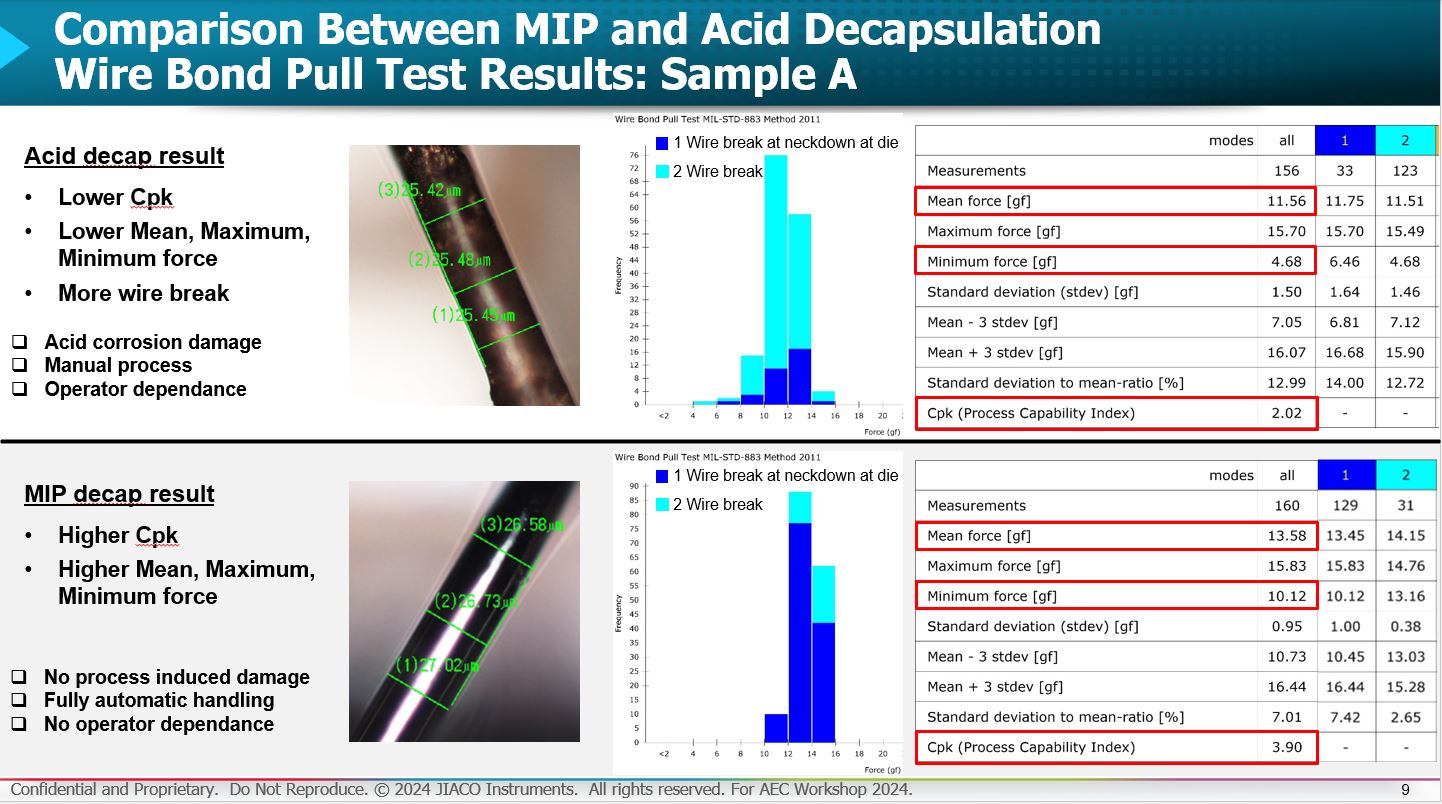
In AEC Q006 qualification, decapsulation is applied on samples before and after thermal stressing to perform wire bond pull and shear tests. It is well known that conventional acid decapsulation introduces damage to the copper wire bonds, which results in a low Cpk value in the subsequent wire bond pull test and causing the results not representing the original sample. Such impact from acid corrosion damage becomes even more severe when the wire diameter is below 25 um or when high Tg mold compound is used. In addition, acid decapsulation can also leave residues on the die surface, introduce damage to the die when there is passivation micro-cracks after thermal stressing, and introduce artifacts to the sample that hinders further root cause failure analysis.
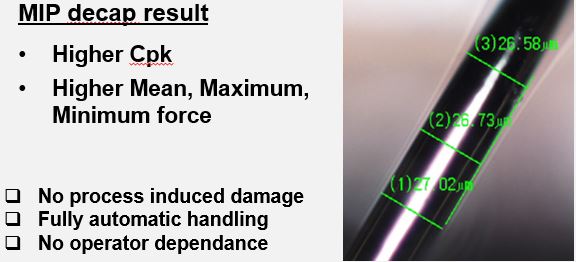
In this work, we present a comprehensive study of using Microwave Induced Plasma (MIP) decapsulation in AEC Q006 qualification. It will be demonstrated that using MIP in qualification has strong advantages over acid decapsulation such as high Cpk value in wire bond pull test, clean die surface, and artifact-free decapsulation that enables efficient root cause failure analysis. Finally, recommendations will be given for the use of MIP decapsulation for AEC Q006 qualification.
Jiaqi Tang (JIACO Instruments. Delft, The Netherlands), Mark McKinnon (JIACO Instruments. Delft, The Netherlands), Clemens Wargers (Eurofins. The Netherlands), Thijs Kempers (Eurofins. The Netherlands)